
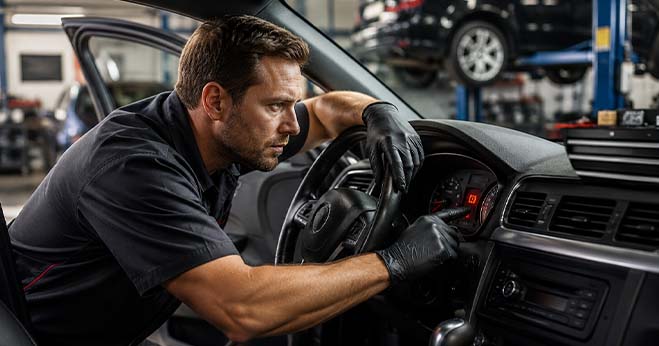
The moment that a red or golden light flashes onto your dashboard display screen is a truly scary experience, particularly if this symbol is connected with your car’s braking capacity. If the brake light in your vehicle is activated, then this is a definite sign that your car’s onboard computer needs immediate attention.
While many drivers may panic or even ignore the warning light in their dashboard displays, the reality is that failing to address the issue is never the right course of action. The braking system is maybe the most important aspect of your vehicle, and the reason for activating the warning brake light may range anywhere from an accidental handbrake activation to total hydraulic fluid failure.
This guide aims to provide you with all the necessary information you need to identify and address the potential causes for the brake light in your car being ligthed. Not only will doing so allow you to save significant amounts of money on costly repairs but, more importantly, it will make sure that you maintain your safety on the roads.
1. Decoding the Dashboard: What the Symbols Mean
Before you even think about opening the bonnet of your vehicle or moving slowly under the vehicle, you should make sure that you know exactly what the dashboards are trying to tell you. Different cars have different symbols for different issues, and if you are having an issue with your brakes being light or you hear a ring on your dashboard, you need to look at the particular symbol that appears on your dash.
- The Main Brake System Warning Light
This is usually represented by a red circle with an exclamation mark (!) inside it or just simply the word “BRAKE” in bright red lettering. This indicates that there is something wrong with the brake system of your vehicle.
- The ABS Indicator Light
Normally, the indicator for the ABS will indicate the letters “ABS” in an icon. This means that the normal brakes are alright but the anti-lock brakes, which prevent the wheels from locking during excessive pressure of the brakes, are not functioning properly due to a problem with the system.
- The Parking Brake Light
Usually, the icon will be the same as the braking system warning light with the difference of the color red “(!)” or “BRAKE,” although some new cars have a symbol with the letter “P.” This light becomes illuminated when the vehicle recognizes the use of the parking brake.
2. Check the Parking Brake First
If you turn your car engine on and find that the brake light indicator is flashing, the first thing you need to do is the simplest thing: test your parking brake.
It is popularly called a hand brake or emergency brake, which works physically through a cable that keeps the car wheels fixed when it is stationary. It is quite usual for a driver to half-release the handbrake, meaning he pushes it down only halfway, making the car move forward but not pushing the sensor switch situated at the bottom of the lever.
In case a brake light warning is on , lift the handbrake lever up forcefully, then depress the button to lower it to the floor. In case you have a foot-operated parking brake pedal, apply forceful pressure on it to fully depress it. In most instances, lowering this lever will make the brake light indicator stop flashing immediately, solving your issue.
3. Inspect Your Brake Fluid Levels
In case the parking brake is fully released, and the brake system indicator light stays on, then the most likely cause for this problem would be a low hydraulic fluid level.
To create the necessary friction that results from pressing the brake pedal, your car uses a unique hydraulic fluid. In the fluid storage tank placed inside your hood, you can find a small float-like sensor. In case the hydraulic fluid level falls below the required “MIN” line, then the sensor lowers itself and closes a switch. As a result, the brake system warning light starts blinking on your dash panel.
How to Check the Fluid:
- Make sure that your car is parked on a flat ground, then open the hood.
- Find the master cylinder container. This is a small clear plastic cylinder, which is usually found just above the engine compartment towards the rear, right in front of the dashboard.
- Look carefully at the sides of the clear plastic cylinder. You should see the labels “MIN” and “MAX”.
- Make sure that the fluid level is within these two marks.
In case there is less fluid, this is exactly what causes the brake light to be on inside the car. It should be noted that just adding more fluid will not necessarily solve the problem since fluid is used in a closed-loop system, and thus, it will not evaporate. If there is less fluid, it can only mean that either fluid has leaked or brake pads need replacement.
4. Worn Brake Pads and Built-In Sensors
One of the main factors responsible for the low level of fluid and the next indication of the brake light warning light is the extreme wear of the brake pads.
Every time you brake while driving, the large friction surface of the brake pads gradually gets worn off. The thinner brake pads require the caliper pistons to be extended further out to apply pressure on the thinner brake pads against the metal rotors.
As a result, due to the further extension of the pistons, more hydraulic fluid is pulled from the tank in the engine area to fill the empty space that has been created. left by the extended pistons. This is a natural process, which results in a slow decline of the fluid level in the reservoir until the pads are extremely thin. At this point, the fluid level drops below the “MIN” mark and activates the brake light warning light.
In addition, many luxury and European cars feature electronic wear sensors that are installed directly in the brake pads. Upon reaching a certain limit of wear, the pads begin rubbing against the metal rotor, causing an electric contact that lights up the dedicated brake warning light in the car’s dashboard.
In the event that you hear squeaking or grinding sounds while pressing the pedal along with your warning light, then most likely, you will need new brake pads.
5. Potential Hydraulic Fluid Leaks
Should you open your fluid tank only to discover it totally devoid of fluid, then you’ve got yourself one serious safety issue. Having zero fluid left in your tank means there is a fluid leak somewhere within the hydraulic braking system.
As you probably know by now, when fluid escapes from a tube, it’s always supported by air. Since air can be compressed, whereas fluid cannot, depressing your pedal will give you a spongy feeling. In extreme cases, the pedal can go right to the floor without putting up much resistance. Needless to say, this poses a severe threat to your safety; the pressure drop will instantly engage the warning brake light.
Fluid leaks can take place at various locations:
- The Master Cylinder: Fluid can escape through the main pump seals, running along the firewall.
- Brake Hoses: Rubber brake hoses connecting steel lines to the wheels can become brittle and leak due to wear and tear.
- Brake Calipers: Rubber seals surrounding the piston of your brake caliper can degrade, resulting in fluid leakage at the wheel level.
Should you suspect any leakage, look under your car to see if there are puddles of liquid which are slippery and oily. They may be clear or of light yellow color. Do not drive the vehicle should you notice any considerable leakage.
6. Malfunctioning Sensors and Electrical Faults
Your car is just a computer on wheels; it is dependent on numerous electronics, wire connections, and sensor devices in order to keep track of the mechanical functioning of its systems. It’s possible for your braking system’s mechanical parts to be in great condition but a faulty sensor may give a wrong signal.
The Parking Lever is Down, Your Fluid is Full to “MAX,” Your Pads are Thick, and There are No Leaks: If this is the case, then you could be suffering from an electrical problem.
- Stuck Float Switch: The small float in the brake fluid storage tank can sometimes stick at the bottom of the reservoir due to collected dirt or impure fluid, telling the computer that your fluid level is low.
- Damaged Parking Brake Switch: The switch that is pressed when you pull your parking brake handle can fail and get stuck, causing the light to remain continuously lit.
- Wiring Damage or Blown Fuses: Your brake system uses several different kinds of sensors, which send information to the computer through wires. A wire malfunction will lead to the lighting up of many dashboard lights.
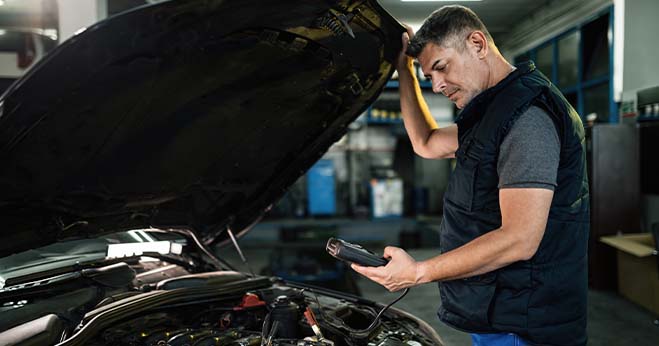
The diagnosis of electrical problems requires a qualified auto mechanic that will have a special OBD-II diagnostic computer capable of reading your specific fault codes.
7. What to Do If the Light Comes On While Driving
Well, when you see the light on the dashboard, there is nothing much to worry about since you do not need to do anything when your car is in your own yard. But, things become entirely different when you start seeing the brake system red light while you are driving on the highway. This is where you need to consider safety measures.
- Don’t Panic: You should not panic because doing so would make you lose control of your car.
- Test the Brakes: Try to test the brakes by pressing your feet lightly on the brake pedal to assess the level of resistance. In case you realize that the pedal is still behaving normally and the car is slowing down, then you must slowly move to the right side to look for a spot where you can stop safely, preferably in the parking area.
- Pedal Sinks: If you feel that stepping on the brake pedal will make your feet sink as if you were stepping on a sponge, then this indicates that you don’t have any hydraulic pressure anymore. Stop pressing on the gas pedal.
- Engine Braking: If you have a manual transmission car, go through all the gears as you come to a stop by letting the engine brake. In case you have an automatic transmission car, switch the gears from “Drive” to a lower gear (usually marked as 3, 2, and L).
- Handbrake Application: When your speed is considerably reduced, you may gradually engage the handbrake, which will assist in coming to a stop. Avoid pulling the handbrake quickly when your speed is still major since it will lock the wheels and cause the vehicle to slip without control.
Finally, park your vehicle off the road, shut off the engine, and contact a towing service. The consequences of driving a vehicle without hydraulic fluid are fatal.
8. Reliable General Automotive Care at Patel Auto Service
In terms of your brakes, there is no room for games, skimping, or anything of that sort when you do not really understand what needs to be done. Whenever you notice that your dashboard light is blinking, then you will want to see a mechanic for the proper diagnosis and repairs to take place.
If your vehicle exhibits signs like a blinking dashboard light, soft brake pedal, or grinding sounds, we at Patel Auto Service are confident that we will be able to help you. The qualified mechanics that work for us use sophisticated computer diagnostic equipment to accurately and properly solve and interpret the codes associated with your dashboard light.
We specialize in performing a range of General Automotive services, which includes but is not limited to things like pad replacement, fluid flushing, hydros leak repairs, and even sensor resets. We promise to examine your parts in detail and provide a fair assessment concerning the condition of those parts and necessary actions to take.
9. Frequently Asked Questions (FAQ)
- What Should I Do If My Brake Light Is On?
In case the light turns out to be red, it is better to refrain from driving and diagnose the cause of this problem.
The red light warns about the presence of a serious problem that affects the car’s security, including the absence of fluid or a hydraulic malfunction. If it is yellow or amber (usually meaning an ABS problem instead of a complete malfunction of the braking system), you can carefully drive to a service station without rushing, maintaining additional following distances due to the lack of an anti-lock braking system.
- Why Does My Brake Light Flash Occasionally ?
Usually, this flashing means there is insufficient fluid that begins to shift in the tank while driving. As you accelerate, brake or turn the car, it moves to one side of the tank. As a result, the sensor float sinks slightly because of the shifting position of the fluid and, therefore, lights up the warning light, which is switched off again as soon as the fluid returns to its place. This symptom points to thin pads or gradual loss of fluid.
- Will brake fluid flushing fix the warning light?
In case the warning light turned on due to the fact that the float sensor got stuck because of contaminated brake fluid, then a brake fluid flush would solve the problem. However, if the warning light appeared due to thin pads or a malfunctioning sensor, a fluid change will do nothing to turn off the warning light.
- How much will it cost to address brake warning light problems?
Everything depends on the specific problem. In case the reason for the warning light appearing was that you left the handbrake engaged, the problem won’t cost you anything since it’s quite simple. In case you’ve noticed that your pads need replacement, you may have to pay $150-$300 for an axle set. The total price in case of a burst hydraulic line, a broken master cylinder, or a faulty ABS computer module would be from $400 to $1,000+.
- How is the red brake light different from the yellow ABS light?
If the red brake light illuminates, there is an issue with the basic ability of your vehicle to stop. The yellow ABS light, on the other hand, signals that there is a malfunction with the computerized system of pulsing the brakes quickly in the case of a slide. In this case, your ordinary ability to stop remains unchanged, but you don’t have skid prevention in wet or icy weather.





Leave A Comment