
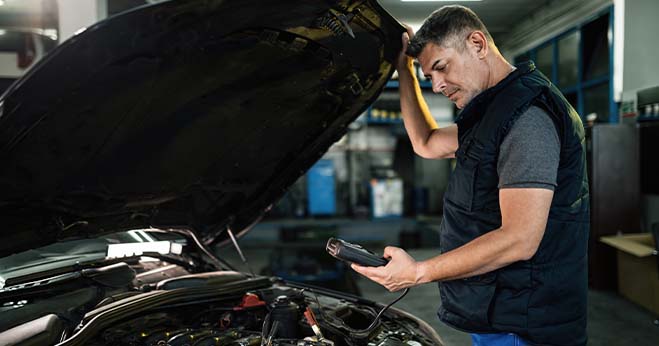
Modern car engineering is truly remarkable. Not only does it rely on having fuel and motor oil on board, but also on a complex computer system of sensors and connections.
In case there is something wrong with the engine or the emissions system, your car signals this to you via a little yellow/orange engine-like symbol on your dashboard.
Should you be looking for information related to the check engine light, chances are that this warning sign has just appeared on your car.
This guide will allow you to get adapt with how modern engines are diagnosed, interpret what your car is trying to tell you, and show you why these problems should be solved quickly.
The Evolution of On-Board Monitoring Systems
In order, for us to understand the importance of the check engine light, we need to understand how much technology has evolved since the early days of automobiles.
In the past, the car used to operate on relatively simple mechanisms. In case of any problem within the engine, all one needed to do was wait for either the sound of roaring noises, massive loss of energy, or even a trail of smoke before they could begin searching for a possible solution.
The current generation of family cars is a good example of what can only be termed as a supercomputer. The current model of cars has an Engine Control Unit (ECU) that constantly oversees the entire network of intelligent sensors.
Given that there are numerous connections between these different sensors, the ECU becomes the brain that controls the whole system. Once the ECU detects any data coming from the sensors that deviates from the norm, it lights up the Check Engine Light and saves the information.
Understanding Solid and Flashing Lights
Whenever you hear someone mention the check engine light, you always think the car will soon break down because of the lit-up light. The importance of the issue depends on whether the light is on constantly or flashing.
Below is a short comparison between the two warnings:
| Warning Type | System Condition | Main meaning | Action to take |
| Solid Light | Not an Emergency | A fault is present, but there will be no harmful damage to the engine | Drive cautiously until you can have your car checked at your earliest convenience. |
| Flashing Light | Emergency Situation | There is a serious fault within the engine, resulting in raw fuel leaking into the exhaust system. | Stop safely, shut down the engine, and seek immediate assistance. |
In the event that your vehicle is running with a solid light, taking your vehicle to the mechanic will probably turn out to be a minor problem with one of your sensors. On the other hand, if your vehicle’s problem causes a flashing light, then continuing with driving will eventually lead to the fuel burning out your catalytic converter.
6 Common Symptoms That Indicate a Check Engine Light Fault
Engine management system issues rarely resolve themselves, and if left untreated, such problems often become worse. By knowing the usual suspects behind an engine management light, you can save yourself from being left stranded by the side of the road. The below list consists of 8 causes for a bad engine management light:
1. A Loose/Faulty/Missing Fuel Cap
Fuel leaks are detected by the vehicle’s drying emissions system, which turns on the engine management light if detected. Such issues are fairly cheap and easy to fix.
2. A Faulty Oxygen (O2) Sensor
This component determines the proportion of unburned oxygen in the car’s exhaust gases and helps calculate the right air/fuel mix. If this device breaks down, your car will consume more petrol than needed.
3. Malfunctioning Spark Plugs/Ignition Coils
A spark plug ignites the air and fuel mixture in the cylinder of your engine. Old spark plugs can cause your engine to misfire.
4. Catalytic Converter Fault
A catalytic converter removes harmful exhaust gases. They generally do not fail alone but as a consequence of some other problem in the vehicle (e.g., bad spark plugs) going unaddressed for an extended period of time.
5. Vacuum Leaks
The vacuum system inside all vehicles is made up of numerous rubber tubes which will inevitably crack or dry out under the intense Australian conditions. The consequence of a vacuum leak is un-metered air entering the engine, creating either power surges or abnormally high idling.
6. Dead/Dying Battery
Today’s automotive computers require precise voltage levels and react quite sensitively even to minor changes. Thus, a failing battery will lead to computer malfunctions.
The High Cost of Ignoring Dashboard Warnings
Delaying an oil change may be a bad habit, but failing to get an engine check light fixed is a huge expense down the line.
Your engine runs on live data and any delay in getting a “band-aid fix” will put you at huge risk of permanent engine damage, and can cost thousands of dollars more than just fixing a small problem. Not only is ignoring this problem risky for your car’s operation, but it causes an expensive chain reaction.
The spark plugs in your engine work hand-in-hand with the catalytic converter. Failure to replace a misfiring spark plug will cause raw fuel from your engine to run through it and overheat the catalytic converter, which can melt within minutes. Instead of fixing the problem with a cheap spark plug change, you’ve now caused serious damage to an expensive exhaust system part.
Guidance for Drivers: What to Do When the Light Comes On
Because of the complexities involved with the modern-day engine sensors, it is vital to be systematic in addressing the situation once the light goes on. The following are the procedures you need to follow in the event that the light comes on.
-
Assess Important Gauges
The first step involves looking at the temperature gauge and the oil pressure gauge. In case either of the two shows any oddness, stop the engine immediately and wait for help from mechanics.
-
Drive Slower and Without Loads
In case there is nothing wrong and the car feels okay, slow down gradually. Do not accelerate heavily or tow loads until the car undergoes a thorough check-up by an expert mechanic.
-
Reattach the Petrol Cap
Once it’s safe, stop the car and tighten the petrol cap properly. The chances are that the fuel cap was loose initially, and it will probably take a while before the light turns off.
Important Questions to Ask Your Mechanic
These are some critical questions that one should ask before handing over their car to the service advisors. The best mechanics will always have an answer for these questions.
- “Do you use bi-directional monitoring?”
With this answer, you will know that you’re dealing with a technician who has the necessary tools. No professional mechanic should depend on a cheap code reader when testing different parts of the engine. Instead, they should use special equipment to perform such tests without disassembling the engine.
- “Are you going to make sure that the part needs to be replaced?”
Make sure that you don’t hire a technician who simply uses a code to replace the parts. It is important that everything is clear that the part or sensor is faulty because they have checked it.
- “Will you provide me with a written estimate of the parts needed before starting work?”
The labour and replacement cost of components must be clear.
DIY Diagnostics: Why Using a Cheap Scanner is a Bad Idea
With all the freely available information out there in YouTube, people may easily think that they can DIY and save a lot of money. Fixing the fuel cap problem is fine by yourself. But when it comes to fixing more complicated engine problems, it is best to get the professionals involved.
The cheap scanner will only provide you with a code (“System Too Lean”), but nothing else. Misreading of the data results in a “parts cannon syndrome” and spending hundreds of dollars on changing sensors which are perfectly fine. This can literally ruin your repair budget while leaving the light burning.
Patel Auto Service Centre: Your Trusted Partner in Marsden Park
It is crucial to choose the right mechanic to ensure that there is no trouble while you are driving.
Patel Auto Service Centre is one of the professional auto service centres inMarsden Park. We can take care of all your diagnostic issues without any hassle, since we are experts at this field. It feels good that we are serving those who live close to us, such as Glendenning and Dean Park
The process of making appointments for you, servicing your car, and driving your car out of our garage assures you that you will have a smooth drive. You should never waste time in solving your check engine light issue.
FAQs
- What would the cost be for diagnosis of the check engine light problem be?
The cost of such service depends on the complexity of work to be done and whether the car in question belongs to a particular brand. Any respected workshop will quote a charge according to their rate for one-hour diagnosis. Therefore, in such cases, the customer has to bear expenses for both the labor involved and the equipment used in the process of diagnosis. - Is an old battery capable of causing problems with the check engine light?
Certainly, today’s cars have high sensitivity levels regarding voltage drop. Therefore, once the battery fails, it will not provide stable voltages, thus possibly causing problems with the operation of computer systems.
- Is the check engine light going to turn off once the issue is fixed?
Yes. If the problem with your car has been a temporary one and resulted from the failure of one of its components, such as an unlocked fuel cap, your computer will realize that everything has returned to normal, and after several “driving cycles,” the warning light will turn off automatically.
- Is it allowed to drive when your check engine light is on?
Yes. Assuming that your warning light remains stationary, it will be fine for you to drive until your next maintenance check. But postponing solving the issue might result in even bigger problems. Nevertheless, should your check engine light blink frantically, stop immediately because your car won’t run properly anymore. Consequently, fuel that hasn’t been burnt will enter your exhaust system and damage your catalytic converter fatally.









Leave A Comment